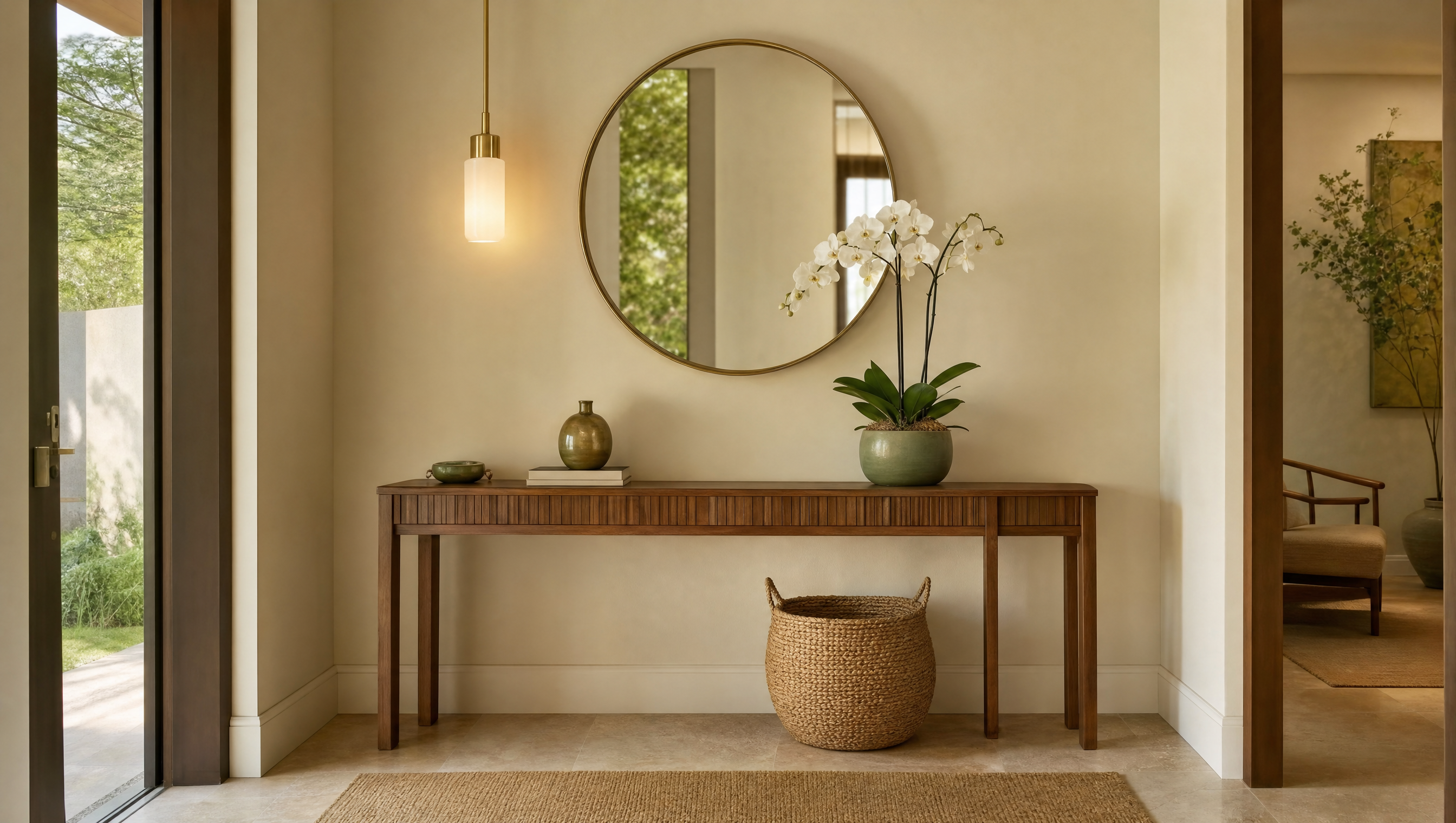
Every school of Feng Shui — however ornate its charts — begins with one simple picture: your home as a landscape that energy moves through. The classics call that energy chi. You don’t need to take the word literally to use the idea. Watch how light, air, sound and people travel through your rooms, and you are already reading chi.
The front door is the mouth of the home
Classical texts call the entry the mouth of chi — the point where the outside world becomes your world. A clear, well-lit, welcoming entrance lets life in; a blocked one starves the whole house. Three small tests:
- Does the door open fully, without scraping a coat rack or a pile of shoes?
- Can you see something beautiful within the first three seconds of entering?
- Is there a place to set down what you carry — keys, bags, the day itself?
If any answer is no, begin there. No compass required.
Chi likes to meander
Energy that rushes in a straight line — a front door aligned with a back window, a long bare hallway — moves through too fast to nourish anything. Energy that has nowhere to go at all — a cluttered corner, a dead-end room — stagnates. The art is in between: slow, curved, purposeful movement. A rug that pauses the eye, a plant that softens a corridor, a lamp that turns a dark corner back into part of the room.
Where energy rests, life happens
The rooms where you sleep, work and eat deserve the most care, because that is where chi — and you — settle for hours at a time. Which brings us to the single most powerful idea in all of Feng Shui: the commanding position. It gets its own article, right here.
Start small. Move one thing this week, and notice what your home does in response.